7 things VALORANT Champions Shanghai group stage revealed
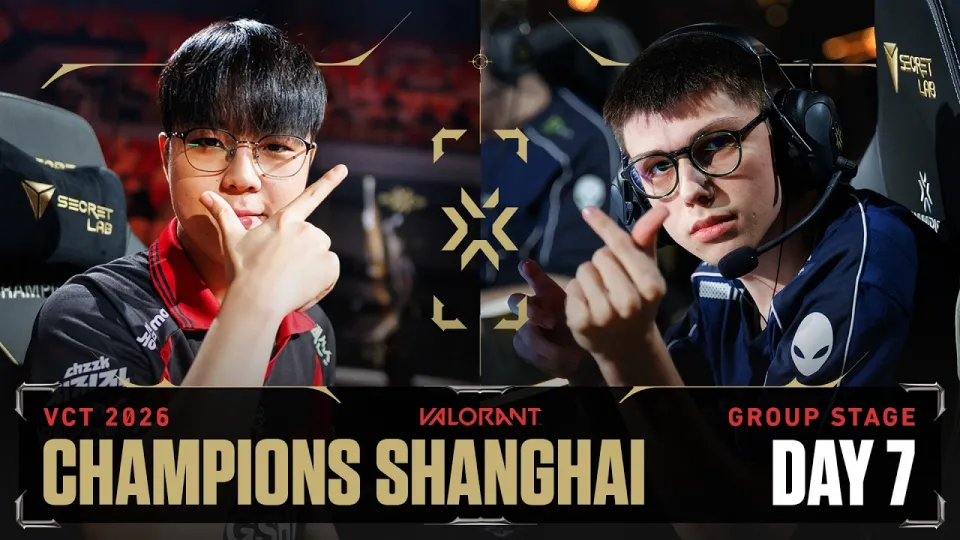
Video: VALORANT Champions Shanghai — Group Stage — Day 7
You can order the same kind of articles for your own video to boost it on YouTube and Google. Just message the Telegram bot @sat_sit_bot. The bot writes and publishes the articles itself (with your YouTube video embedded) on popular topical websites (no ads). Your first 50 articles are free.
· based on the channel VALORANT Champions Tour
Key takeaways
- 16 teams from Americas, CN, EMEA and Pacific compete at VALORANT Champions Shanghai for the 2026 world title.
- The event runs September 24 to October 18, with Day 7 of the group stage streamed by the VALORANT Champions Tour channel.
- Two different teams won Masters events in 2026, so Shanghai is the first true tiebreaker of the season.
- Viewer chat focused on repeated tech pauses, questionable utility usage from CN teams and one accidental Yoru clone moment.
- Official updates and clips are posted through the VALORANT Esports X account at https://x.com/valorantesports.
VALORANT Champions Shanghai is the 2026 world championship where 16 teams from Americas, CN, EMEA and Pacific fight for the biggest trophy of the year, and Day 7 of the group stage is where the bracket starts to take its real shape. The stream, published by the VALORANT Champions Tour, mixes decisive map results with a running debate about tech pauses and the gap between Chinese teams and the rest of the world. For schedules, clips and announcements, the official VALORANT Esports X account is the fastest source.
What the group stage format actually decides
The group stage at VALORANT Champions Shanghai is a sorting mechanism, not a coronation. Sixteen qualified rosters arrive from four regions, and every series in the group phase changes seeding, elimination risk and which side of the bracket a team lands on. That matters more than usual in 2026 because two different squads lifted Masters trophies earlier in the season, which means there is no single dominant favorite walking into Shanghai. A group-stage loss does not end a run, but it can force a team into a knockout path stacked with the other region winners. The description of the Day 7 broadcast frames the event exactly this way: familiar names, new contenders and a fearless generation of challengers, all compressed into a September 24 to October 18 window.
Why tech pauses dominated the Day 7 conversation
Tech pauses became the loudest talking point of the broadcast, and viewers noticed them piling up across the day. A pause in a VALORANT server is not cosmetic: it freezes economy decisions, breaks the rhythm of a team that just won a force round, and gives coaches an extra window to talk. When pauses repeat within a single series, the competitive cost lands unevenly, because the team that was building momentum is the one that loses it. The chat reaction was blunt, with multiple comments asking why there were so many interruptions and one calling it an endless series. For a championship-level event, that is a production problem as much as a server problem, and it is the kind of thing that shapes how a VOD watches back later.
The Yoru clone moment that confused everyone
One round produced the day's most replayed visual gag: a Yoru clone that briefly looked like it was helping hold a site rather than baiting an angle. Yoru's Fakeout is designed to mimic a real player, so when a clone walks into a defensive setup and nobody punishes it, the result looks like a teammate doing a job. The moment is funny, but it also shows how much of high-level VALORANT is about information discipline. A team that shoots a clone gives away a position; a team that ignores it can be walked on by the real Yoru. Small reads like that decide eco rounds and 5v2 retakes, which is exactly where the day's margins were.
China's group-stage problems in plain numbers
The most critical viewer thread was about CN teams losing rounds that should have been closed out. Comments pointed to lost anti-eco rounds, dropped 5v2 advantages and utility usage that fell apart once set strategies were disrupted. That is a specific diagnosis, not a regional insult: it describes teams that execute rehearsed defaults well but improvise poorly when the opponent breaks the script. The counter-argument also appeared in chat, noting that stronger teams from other regions missed the event entirely, so the CN showing is not automatically proof of a weaker region. Both points can be true. What the group stage measures is adaptation speed, and on Day 7 the CN squads were slower to adapt than their opponents.
How to watch the Day 7 VOD without spoilers
The Day 7 broadcast is long, and the cleanest way to watch it is deliberately. Start with the spoiler-blocked timestamp list that viewers maintain in the comments, which lets you jump between maps without seeing a scoreline first. Skip past the tech pauses rather than sitting through them, since a paused server produces no useful gameplay. If you are studying a specific team, watch their attack halves first: that is where the utility discipline and the eco decisions that chat complained about are most visible. The full stream is available on the VALORANT Champions Tour channel, and the official channels below post highlights and results if you want the short version instead.
Useful links
- https://x.com/valorantesports
- https://www.facebook.com/ValorantEsports/
- https://www.instagram.com/valorantesports/
- https://www.tiktok.com/@valorantesports
- https://www.twitch.tv/valorant
What Day 7 means for the Shanghai knockout race
Day 7 of the VALORANT Champions Shanghai group stage narrowed the field without settling it, and the takeaways are concrete: tech pauses cost momentum, CN teams need faster improvisation, and the Yoru clone round is a reminder that information discipline wins close maps. With two Masters winners already in the field, the bracket is set up for a genuine clash of eras rather than a coronation. Follow the official VALORANT Esports X account for the next match schedule and results, and watch the full Day 7 broadcast on the VALORANT Champions Tour channel for the unedited version.
Questions & answers
How many teams play at VALORANT Champions Shanghai?
Sixteen teams qualify from four regions: Americas, CN, EMEA and Pacific. They compete for the 2026 VALORANT world championship title across a group stage and knockout bracket, with the event running from September 24 to October 18.
Why were there so many tech pauses during Day 7?
The broadcast featured repeated technical interruptions that viewers flagged in the comments. Server or production pauses freeze the round state and interrupt a team's momentum, which is why they drew so much criticism during a championship-level stream.
Did any team from China look competitive in the group stage?
Viewer discussion was split. Critics pointed to lost anti-eco rounds, dropped 5v2s and rigid utility usage, while others noted that strong teams from other regions did not qualify at all, so the CN results are not a clean measure of regional strength.
What was the Yoru clone moment everyone mentioned?
In one round a Yoru Fakeout clone appeared to be helping hold a site, because defenders did not punish it. It was a funny visual, but it highlighted how much of pro VALORANT depends on correctly reading information and baiting utility.
Source: VALORANT Champions Shanghai — Group Stage — Day 7 · Markdown version